Have you ever clicked a button on your phone to order a pair of shoes, a new book, or even groceries, and had them arrive at your doorstep the very next day? In 2026, we have become used to this kind of speed. We treat it like magic. You press a button, and the item appears. But it is not magic. It is the result of a massive, complex, and fascinating system working 24 hours a day, seven days a week. This system is called Supply Chain and Logistics Management.
It is the invisible engine that runs the global economy. Without it, the shelves at the supermarket would be empty, hospitals would run out of medicine, and you would not be able to buy the gas for your car. For most people, this industry is a mystery. We see the delivery trucks on the highway, but we rarely think about the journey that package took to get there. This guide is going to pull back the curtain. We will strip away the complicated business textbooks and use simple, plain English to explain exactly how products move from a factory in one corner of the world to a customer in another. Whether you are a student, a business owner, or just curious about how the world works, this is the story of how we keep things moving.
What is Supply Chain Management and Why Should You Care?
Imagine you want to bake an apple pie. You need apples, flour, sugar, and butter. You have to go to the store to buy them. But how did the store get them? The apples came from an orchard, the flour from a wheat farm, the sugar from a cane field, and the butter from a dairy farm. Before they got to the store, they had to be harvested, processed, packaged, and shipped.
Supply Chain Management (SCM) is the management of this entire flow. It is the big picture. It looks at the whole timeline of a product, from the raw material (like the wheat in the field) all the way to the finished product (the bag of flour in your kitchen). It even includes what happens to the packaging after you throw it away.
Why should you care? because supply chain management determines the price and availability of everything you own. If a supply chain is managed well, products are cheap and always in stock. If it is managed poorly, products become expensive or impossible to find. Remember when you couldn’t find toilet paper or computer chips a few years ago? That was a supply chain failure. SCM is about connecting the dots between suppliers, manufacturers, warehouses, transporters, and retailers to make sure everyone is talking to each other and working together efficiently.
Supply Chain vs. Logistics: Understanding the Key Differences
People often use the words “supply chain” and “logistics” as if they mean the same thing, but they are actually different. Think of the human body. The Supply Chain is the brain. It makes the plans, decides the strategy, and coordinates all the different parts. Logistics is the muscle. It does the heavy lifting.
Logistics is specifically about the movement and storage of goods. It answers the questions: “How do we get this box from Point A to Point B?” and “Where do we put it when it gets there?” Logistics focuses on trucks, ships, airplanes, and warehouses. It deals with shipping routes, fuel costs, and delivery schedules.
Supply Chain Management is broader. It answers the questions: “Who should we buy the raw materials from?” “How much should we charge for the product?” and “How do we design the product so it is easier to ship?” Logistics is a part of the Supply Chain, just like your bicep is a part of your body. You cannot have a good supply chain without good logistics, but logistics alone is just moving boxes without a plan. The best companies in the world, like Amazon or Apple, are masters of both. They plan brilliantly (Supply Chain) and they move fast (Logistics).
The Journey of a Product: From Raw Materials to Your Doorstep
To really understand how this works, let’s trace the life of a simple object: a cotton T-shirt. The journey begins on a farm, perhaps in India or the United States, where cotton is grown. This is the “Raw Material” stage. The cotton is harvested and baled.
Logistics kicks in to move these bales to a spinning mill, often in a different country. Here, the cotton is turned into thread. Then, it moves again to a knitting factory to be turned into fabric. Then it moves to a dyeing facility to get its color. Finally, it goes to a factory where it is cut and sewn into a shirt. This is the “Manufacturing” stage.
Now the shirt is finished, but it is sitting in a factory in Vietnam or Bangladesh. It needs to get to you. It is packed into a shipping container and loaded onto a massive ship. This ship crosses the ocean, which can take weeks. When it arrives at a port, say in Los Angeles, the container is unloaded by giant cranes. A truck picks up the container and drives it to a Distribution Center. Here, the shirts are taken out of the container and put on shelves. Finally, when you click “buy,” a worker picks the shirt, puts it in a bag, and hands it to a delivery driver who brings it to your house. This entire relay race involves dozens of companies and thousands of people, all working in sync.
The Art of Inventory Management: Balancing Supply and Demand
One of the hardest parts of running a business is figuring out how much stuff to keep on hand. This is called Inventory Management. Inventory is simply the goods you have available to sell.
If you have too much inventory, it is expensive. You have to pay rent for the warehouse space to store it. You have to pay for insurance. And there is a risk that the product will go bad (if it is food) or go out of style (if it is fashion) before you sell it. This is called “holding cost.” It is money sitting on a shelf doing nothing.
But if you have too little inventory, you have a bigger problem: “Stockouts.” If a customer comes to your store to buy a TV and you don’t have it, they won’t wait. They will go to your competitor. You lose the sale, and you might lose the customer forever. The goal of inventory management is to find the “Goldilocks” zone—not too much, not too little, but just right. We use data and math to predict how much people will buy so we can order exactly the right amount. This is often called “Just-in-Time” inventory, where the parts arrive exactly when they are needed, reducing the need for expensive storage.
Warehousing and Distribution: More Than Just Storage Sheds
When we think of a warehouse, we often imagine a dusty, dark building filled with piles of boxes. But modern warehouses, often called Fulfillment Centers, are some of the most high-tech places on earth. They are the heart of the logistics network.
Inside a modern warehouse, everything is organized by a computer system called a Warehouse Management System (WMS). When a shipment arrives, the computer tells the workers exactly where to put it. It keeps track of every single item. If you have 10,000 sneakers in stock, the WMS knows exactly which shelf the Size 10 Red ones are on.
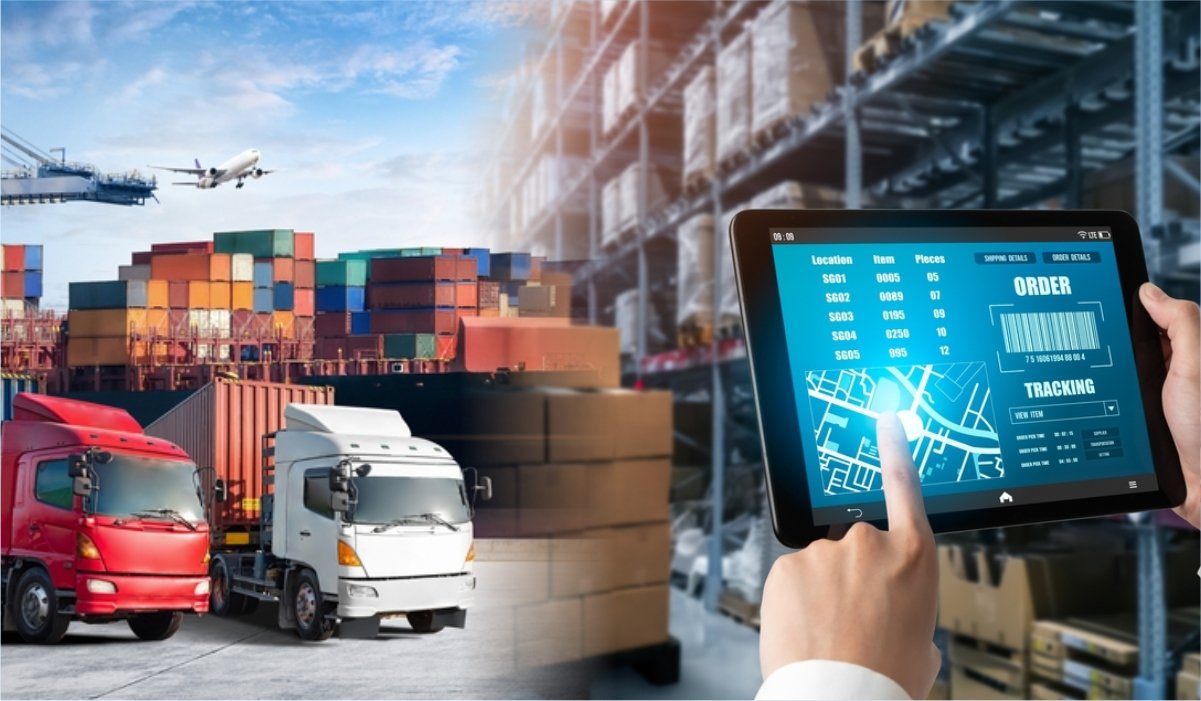
When an order comes in, the warehouse springs into action. This process is called “Pick and Pack.” A worker (or a robot) receives the order on a screen. The system calculates the fastest walking route to get the items. The worker picks the item, scans it to confirm it is correct, and sends it to the packing station. There, another worker puts it in a box, adds the shipping label, and sends it down a conveyor belt to the truck. Efficiency is everything here. Saving just five seconds on every order adds up to millions of dollars a year for big companies.
Transportation: The Bloodline of the Global Economy
Transportation is the physical movement of goods. There are four main ways we move things: Road, Rail, Air, and Sea. Each one has its own strengths and weaknesses, and a good logistics manager knows which one to choose.
Sea Freight is the king of international trade. Giant cargo ships can carry thousands of containers at once. It is incredibly cheap to ship things by sea. However, it is very slow. It can take a month for a ship to cross the ocean. This is best for heavy, non-perishable items like cars, furniture, and electronics.
Air Freight is the opposite. It is incredibly fast. You can get a product from China to New York in 24 hours. But it is very expensive. It is used for high-value items like jewelry, medicine, or the latest iPhone launch, where speed is more important than cost.
Rail Freight is great for moving heavy stuff across land, like coal, grain, or steel. It is cheaper than trucking but limited to where the tracks go.
Road Freight (Trucking) is the most common. Trucks are flexible. They can go anywhere there is a road. They are used for the “Last Mile”—the final trip from the local warehouse to your front door. Almost everything you buy was on a truck at some point in its life.
The Role of Technology: How Robots and AI are Changing the Game
Technology has completely revolutionized supply chains. In the past, people used pen and paper to track inventory. Today, we use Artificial Intelligence (AI) and robotics.
One of the biggest changes is Tracking. Thanks to GPS and barcodes, we can see exactly where a package is at any moment. You know that little map on your phone that shows the delivery driver getting closer? That is logistics technology. It gives customers peace of mind and helps companies spot delays instantly.
Inside the warehouse, Robots are taking over the heavy lifting. Companies like Amazon use small orange robots that slide under heavy shelves and lift them up, carrying the shelf to the human worker. This saves the human from walking miles every day. We also have Drones being tested for delivery. Imagine a small flying robot dropping a package in your backyard.
AI helps with prediction. Computers analyze weather patterns, traffic data, and buying habits to predict problems. For example, if a hurricane is forming in the Atlantic, the AI might tell the supply chain manager to re-route ships to a different port before the storm even hits. This ability to see the future helps avoid disasters.
Navigating Challenges: Dealing with Disruptions and Delays
If the last few years have taught us anything, it is that supply chains are fragile. They can break. When the COVID-19 pandemic hit, factories closed, borders shut down, and suddenly we couldn’t get basic goods. When a giant ship got stuck in the Suez Canal, it blocked trade between Europe and Asia for days, costing billions of dollars.
These events are called “Disruptions.” A good supply chain manager is essentially a professional problem solver. They spend their days asking “What if?” What if the factory burns down? What if the price of gas doubles? What if the truck drivers go on strike?
To deal with this, companies are building “Resilience.” This means not putting all your eggs in one basket. Instead of buying all your parts from one factory in one country, you might buy from three different factories in three different countries. It costs a little more money to set up, but it is an insurance policy. If one factory stops, the others can keep going. Resilience is about surviving the storm so that the customer never notices there was a problem.
The Green Revolution: Sustainability in Supply Chains
Moving things around the world takes a lot of energy. Ships burn oil, trucks burn diesel, and planes burn jet fuel. This creates a lot of pollution. In 2026, customers and governments are demanding that companies clean up their act. This is the push for “Green Logistics.”
Companies are looking for ways to reduce their Carbon Footprint. One way is to optimize routes. Software can plan a delivery route that uses the least amount of gas by avoiding left turns (which require idling) and traffic jams. UPS famously designs their truck routes to make mostly right turns to save fuel.
We are also seeing a shift to Electric Vehicles. Electric delivery vans are becoming common in cities. They are quiet and don’t produce exhaust fumes. Packaging is another big area. Companies are trying to use less plastic and more recycled cardboard. They are also trying to “ship less air.” Have you ever received a huge box with a tiny item inside? That is wasteful. Smart packaging machines now cut the box to the exact size of the item, allowing more boxes to fit in the truck, which means fewer trucks on the road.
The Future of Logistics: What to Expect in 2026 and Beyond
So, where is this all going? The future of supply chain and logistics is faster, smarter, and closer to you. We are moving toward “Hyper-Local” fulfillment. Instead of one giant warehouse in the middle of the country, companies are building hundreds of tiny warehouses in city centers. This allows for delivery in one or two hours, not just two days.
We will see more Autonomous Vehicles. Self-driving semi-trucks are already being tested on highways. These trucks can drive 24 hours a day without needing to sleep, which will make shipping much faster and cheaper.
We will also see the rise of 3D Printing. Imagine if, instead of shipping a spare part for your car from Germany, the local mechanic just downloaded the file and printed it right there in the shop. This would eliminate the need for shipping entirely for certain products. The supply chain would move digital files instead of physical boxes.
Conclusion: The Invisible Force Moving the World
Supply Chain and Logistics Management is the industry that never sleeps. It is the complex web of connections that keeps our modern life running smoothly. It combines the logic of mathematics, the power of heavy machinery, and the strategy of a chess game.
While we might only think about it when a package is late, the reality is that logistics is a miracle of human cooperation. It allows a farmer in Brazil to sell coffee to a banker in London. It allows a factory in Korea to build a phone for a student in Canada. It connects us all.
As we look to the future, this industry will continue to evolve. It will become greener, more automated, and even faster. But the core goal will remain the same: getting the right product, to the right place, at the right time, for the right price. The next time you see a delivery truck or open a package, take a second to appreciate the incredible journey it took to get to you. It truly is the force that moves the world.