When you look at a city skyline, you see towering skyscrapers, beautiful bridges, and cozy homes. You see the result of human hard work and engineering. But what you don’t see is the danger that went into building them. Construction is one of the most important industries in the world. It provides the roofs over our heads and the roads we drive on. However, it is also one of the most dangerous jobs on the planet. Every single day, construction workers face risks that most people can’t even imagine. They work at dizzying heights, handle high-voltage electricity, operate massive machines that could crush a car in seconds, and breathe in dust that can scar their lungs.
Safety in construction is not just a nice idea; it is a matter of life and death. It is the promise that every worker will go home to their family at the end of the day in the exact same condition they arrived. Compliance, which means following the laws and rules, is the roadmap we use to keep that promise. Many people think safety rules are boring or that they slow down the work. But the truth is that a safe construction site is a productive one. Accidents stop work, cost millions of dollars, and destroy lives. This guide is going to walk you through the essential world of construction safety. We will use simple, plain English to explain the risks, the gear, the laws, and the mindset needed to build the world safely.
Why Construction Safety Rules Are Often Written in Blood
There is a grim saying in the safety industry: “Safety regulations are written in blood.” This means that almost every rule we have today exists because someone, somewhere, got hurt or died because that rule didn’t exist yet. In the past, construction was the Wild West. Workers walked on steel beams hundreds of feet in the air without ropes. They dug deep trenches without supporting the walls. They breathed in asbestos without masks. The result was tragedy. Thousands of workers died every year building the cities of the 20th century.
Today, we know better. We understand that accidents are not “bad luck.” They are caused by unsafe conditions or unsafe behaviors. We know that gravity is unforgiving. If you fall from a roof, gravity does not care if you are a good person or a skilled carpenter. We know that electricity is invisible and strikes faster than you can blink. Because we know these things, we have a moral duty to prevent them. Safety is not about restricting freedom; it is about controlling chaos. It is about recognizing that a construction site is a hostile environment and taking steps to tame it. When a site manager enforces a rule, they aren’t trying to be mean; they are trying to stop history from repeating itself.
Understanding Compliance: It Is More Than Just Paperwork
For many contractors, the word “compliance” sounds like a headache. It sounds like hours of filling out forms, paying fees, and dealing with government inspectors. But compliance is actually your best friend. In the United States, the main body for this is OSHA (Occupational Safety and Health Administration). In other countries, there are similar organizations. Their job is to set the minimum standards for safety.
Think of compliance as the baseline. It is the “C grade” of safety. It tells you the absolute minimum you must do to not break the law. For example, the law might say, “You must provide fall protection if the worker is more than six feet off the ground.” If you don’t do this, you are non-compliant. You can be fined thousands of dollars, your site can be shut down, and you can even go to jail if someone dies due to your negligence.
But compliance goes beyond just avoiding fines. It creates a level playing field. If one company spends money on safety gear and training, and another company cuts corners to save money, the dangerous company might win the bid because they are cheaper. Compliance laws ensure that everyone has to play by the same rules. It stops “race to the bottom” pricing where safety is sacrificed for profit. Following the codes for electrical wiring, plumbing, and structural integrity also ensures that the building is safe for the people who will eventually live or work there. Compliance protects the workers during the build and the public after the build.
The Armor of the Job: Personal Protective Equipment Explained
If a construction site is a battlefield, then Personal Protective Equipment (PPE) is the soldier’s armor. You would never send a knight into battle without a shield, and you should never send a worker onto a site without PPE. This gear is the last line of defense. We always try to remove the hazard first—for example, by putting a guardrail up so nobody can fall—but when the hazard is still there, PPE saves lives.
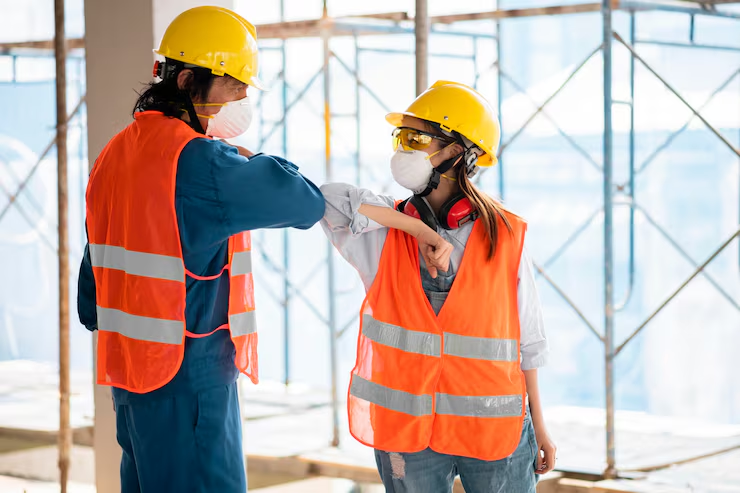
The most iconic piece of PPE is the Hard Hat. It protects the brain. On a construction site, wrenches fall from scaffolds, birds drop rocks, and workers bump their heads on low beams. A hard hat absorbs the shock. It has a suspension system inside that keeps the plastic shell floating above your skull, so the impact is spread out. Then you have Safety Glasses. Eyes are soft and fragile. A tiny splinter of wood or a spark from a grinder can cause permanent blindness. Modern safety glasses are made of polycarbonate, which is strong enough to stop a nail fired from a gun. High-Visibility Vests are crucial. Construction sites are full of moving trucks and cranes. If a driver can’t see you, they can’t avoid you. Neon yellow and orange vests with reflective strips make you pop out against the background of dirt and concrete. Steel-Toed Boots protect your feet. If you drop a heavy beam or step on a rusty nail, these boots are the difference between a bruise and a broken foot or a tetanus infection. Finally, Gloves protect your hands from cuts, burns, and chemicals. PPE only works if you wear it. Having it in your truck doesn’t count.
Conquering Gravity: Preventing Falls on the Job Site
Gravity is the number one killer in construction. Falls account for more than one-third of all construction deaths. This is a terrifying statistic because almost all falls are preventable. Whether it is falling from a roof, a ladder, or scaffolding, the result is the same. The human body is not designed to survive impacts from height.
To fight this, we use a system called “Fall Protection.” The most common tool is the Personal Fall Arrest System. This looks like a full-body harness with straps around your legs, chest, and shoulders. It connects to a lanyard, which connects to a secure anchor point on the building. If you slip, the lanyard catches you. It usually has a “shock absorber” built in to slow you down gently so the sudden stop doesn’t break your back.
But gear isn’t enough. We also need Guardrails. If there is an open edge on a floor or a roof, you must put up a rail. It acts like a fence. We also need to be careful with Ladders. Ladders seem simple, but they are dangerous. Workers often stand on the very top step (which you should never do) or set the ladder on uneven mud. A ladder should always extend three feet past the roofline so you have something to hold onto when you get off. It should be tied off at the top so it doesn’t slide sideways. Respecting gravity means never trusting your balance alone. You always need a backup plan.
Respecting the Machines: Heavy Equipment Safety
A construction site is home to monsters. We have excavators that can dig a swimming pool in an hour, cranes that can lift tons of steel, and bulldozers that can push down trees. These machines are incredible, but they are also blind. The operator sitting in the cab of a giant dump truck has huge “blind spots.” They cannot see a person standing right behind the rear tire.
Safety around heavy equipment relies on two things: Separation and Communication. Separation means keeping people away from machines. You should have marked walkways for workers that are far away from where the trucks are driving. You should use plastic fencing to create a “Danger Zone” around a swinging crane. Communication means using a “Spotter.” A spotter is a person on the ground wearing a bright vest who uses hand signals to tell the operator where to go. The operator should never move the machine unless they can see the spotter.
Workers also need to make eye contact. If you need to walk past a bulldozer, stop. Wave at the driver. Wait for them to wave back or nod. This confirms that they see you. Never assume they know you are there. Also, never walk under a suspended load. If a crane is holding a bundle of bricks in the air, do not walk under it. If the strap breaks, those bricks will fall instantly. Always walk around.
The Invisible Killers: Electrical and Chemical Hazards
Not all dangers on a construction site are big and loud like a bulldozer. Some are silent and invisible. Electricity is one of the most deadly. On a job site, there are temporary power lines running everywhere. Extension cords get dragged through puddles. Drills cut into walls where live wires might be hiding.
Current as low as a small lightbulb can kill a human if it crosses the heart. To stay safe, we use GFCI outlets (Ground Fault Circuit Interrupters). These are the buttons you see on bathroom outlets. They sense if electricity is “leaking” (like if it is going through your body to the ground) and shut off the power in a fraction of a second. We also use a process called Lockout/Tagout. If an electrician is fixing a circuit, they put a physical lock on the breaker box so nobody can accidentally turn the power back on while they are touching the wires.
Chemicals are another silent threat. Construction uses glue, paint, solvents, and insulation. Dust is a major issue. Cutting concrete creates “Silica Dust.” This dust is so fine you can’t see it, but if you breathe it in, it turns to cement in your lungs and causes a disease called Silicosis. Workers must wear respirators (masks) and use saws that spray water to keep the dust down. Asbestos and lead paint in older buildings are also toxic. You cannot just smash them with a hammer; you have to call in specialists to remove them safely.
Communication is Key: Signs, Signals, and Toolbox Talks
A safe construction site is a loud place, but it is also a place where communication must be clear. Misunderstanding an instruction can lead to disaster. If the crane operator thinks you said “drop it” when you actually said “stop it,” people get hurt.
This is why we use standard Hand Signals. Everyone on the site needs to know the universal sign for “stop,” “go,” “up,” and “down.” We also use Signage. A construction site should be covered in signs. “Danger: High Voltage,” “Hard Hat Area,” “Exit Here.” These signs are not decorations; they are instructions. They need to be in multiple languages if the crew speaks different languages. You cannot assume everyone reads English.
The most important communication tool is the Toolbox Talk. This is a short, informal meeting held every morning before work starts. The foreman gathers the crew and talks about the specific risks for that day. “Today we are digging a trench, so watch out for the excavator.” “Today it is raining, so the scaffolding will be slippery.” These talks keep safety fresh in everyone’s mind. They remind workers that safety changes every day depending on the weather and the task. It is a chance for workers to ask questions and point out dangers the boss might have missed.
Building a Culture of Care: Why Attitude Matters Most
You can buy all the helmets in the world and write a thousand rulebooks, but if the workers don’t care, accidents will still happen. Safety is not just about gear; it is about culture. A “Safety Culture” is the shared belief that safety is more important than speed.
In a bad culture, workers are afraid to speak up. If they see a frayed wire, they ignore it because they don’t want to get yelled at for slowing down the job. They take risks to finish faster because the boss is pressuring them. This is a ticking time bomb. In a good culture, every worker is a safety officer. If a young apprentice sees the boss walking without a hard hat, they feel confident enough to say, “Hey boss, put your hat on.” And the boss says, “Thank you.”
Creating this culture starts at the top. The owners and managers have to lead by example. They have to praise workers for being safe, not just for being fast. They have to stop the job if it gets unsafe, even if it costs money. When workers know that their company actually cares about their lives, they take ownership. They look out for each other. They become their “brother’s keeper.” This attitude shift is the most powerful safety tool of all.
The High Cost of Cutting Corners: Fines and Reputation
Some contractors think safety is too expensive. They think PPE costs too much money and training takes too much time. But they are looking at the math wrong. The cost of an accident is always higher than the cost of prevention.
First, there are the direct financial costs. If OSHA catches you breaking the rules, the fines can be massive—tens or hundreds of thousands of dollars. If a worker gets hurt, your insurance premiums skyrocket. You have to pay for their medical bills and their lost wages. Then there are the legal costs. If a member of the public gets hurt, or if a worker dies, the lawsuits can bankrupt a company. You will spend years in court.
But the biggest cost is your Reputation. In the construction industry, your name is everything. If you are known as the “unsafe company,” nobody will hire you. Good clients don’t want the risk of a headline saying “Worker Dies at XYZ Project.” Skilled workers don’t want to work for you because they value their lives. A bad safety record can destroy a business that took decades to build. On the other hand, a spotless safety record is a marketing tool. It tells clients that you are professional, organized, and reliable. Investing in safety is investing in the future of your business.
Conclusion: Building a Future Without Accidents
Construction is a noble profession. It is the act of shaping the world, taming the elements, and creating spaces for humanity to thrive. But it should not demand a blood sacrifice. The days of accepting accidents as “part of the job” are over. We have the technology, the knowledge, and the laws to make construction safe.
Achieving a zero-accident workplace is difficult, but it is the only acceptable goal. It requires constant vigilance. It requires checking your harness every single time you put it on. It requires walking the long way around the crane every single time. It requires speaking up when something feels wrong.
Safety is a partnership between the government (compliance), the company (culture), and the worker (action). When these three things align, we can build the tallest towers and the deepest tunnels without losing a single life. So, whether you are a project manager, a skilled tradesperson, or a DIY enthusiast fixing your deck, remember: Safety is not a rule you follow to avoid a ticket. It is a value you live by to ensure you are there to enjoy the fruits of your labor. Put on your hard hat, tie off your ladder, and let’s build safely.