When you drive through a city, you see skyscrapers touching the clouds, massive shopping malls, sprawling warehouses, and busy factories. We often take these buildings for granted. We work in them, shop in them, and buy products made inside them. But have you ever stopped to think about how they actually get built? Unlike building a house, which is a project for one family, building a commercial or industrial structure is a massive operation. It involves millions of dollars, hundreds of workers, and complex engineering that keeps our modern economy running.
This is the world of Commercial and Industrial Construction. It is a high-stakes industry where precision is key. A small mistake in a residential home might mean a drafty window. A small mistake in a factory could mean a chemical leak or a production line that stops working. While they share some similarities with building a house—like needing a foundation and a roof—the scale and the purpose are completely different. In 2026, this industry is evolving faster than ever with new technologies and green building practices. This guide is going to walk you through the fascinating process of how we build the places where business happens. We will use simple, plain English to explain the differences, the challenges, and the incredible teamwork required to turn a blueprint into a skyline.
What is the Real Difference Between Commercial and Industrial Building
First, we need to clear up a common confusion. People often use “commercial” and “industrial” as if they are the same thing, but they are very different beasts. Think of it this way: Commercial construction is about people; Industrial construction is about things.
Commercial construction focuses on buildings where people go to do business. This includes office towers, hotels, shopping malls, restaurants, hospitals, and schools. The design focus here is on comfort, aesthetics, and traffic flow. You want the building to look impressive. You want the lobby to be welcoming. You care about the air conditioning being quiet and the elevators being fast. The goal is to create an environment where customers want to spend money and employees want to work.
Industrial construction, on the other hand, focuses on manufacturing and distribution. This includes power plants, oil refineries, factories, warehouses, and data centers. Here, nobody cares if the lobby is pretty. The design focus is on functionality and efficiency. Can the floor support a ten-ton machine? Is the ceiling high enough for a crane? Is there enough electricity to run the production line 24 hours a day? Industrial buildings are often just shells designed to protect the expensive machinery inside. Understanding this difference is the first step in planning, because a warehouse needs a completely different team of experts than a luxury hotel.
The Master Plan What Happens Before the First Shovel Hits the Dirt
You cannot just buy a piece of land and start pouring concrete. The pre-construction phase is arguably the most critical part of any major project. This is where the dream is turned into a plan. It starts with site selection. Developers have to look at the location carefully. For a mall, you need to be near highways so shoppers can reach you. For a factory, you might need to be near a rail line or a port to ship your goods.
Once the land is chosen, the permitting process begins. This is often the longest and most frustrating part. You have to prove to the city that your building is safe. You have to show that it won’t hurt the environment. You have to check zoning laws—you can’t build a noisy factory next to a quiet neighborhood. Engineers do “soil testing” to make sure the ground is strong enough to hold a massive structure. If the soil is too soft, the building could sink.
Then comes the design. Architects work with structural engineers to draw the blueprints. In the old days, these were 2D drawings. Today, we use 3D computer models that let us “walk through” the building before it exists. This allows us to spot problems—like a pipe hitting a beam—before we waste money building it. This planning phase can take months or even years, but every hour spent here saves huge amounts of money later.
Building for Strength Why Steel and Concrete Are the Kings of Construction
If you look at a house, it is mostly made of wood. Wood is cheap, easy to cut, and great for small structures. But you cannot build a skyscraper out of wood. It isn’t strong enough. Commercial and industrial buildings rely on the heavyweights of the material world: steel and concrete.
Steel is the skeleton. It is incredibly strong for its weight. Steel beams can span long distances without needing a column in the middle. This is why office buildings have huge open floors and why airplane hangars can hold massive jets. Steel is also flexible; if the wind blows hard or an earthquake hits, steel bends slightly without breaking. This keeps the building standing.
Concrete is the muscle. It is used for foundations, floors, and walls. Concrete is great at handling “compression”—the weight of the building pushing down on it. In industrial settings, the concrete floor is vital. It has to be perfectly flat so forklifts don’t tip over, and it has to be reinforced with metal bars (rebar) to stop it from cracking under the weight of heavy machinery. We also see a lot of glass in commercial buildings. Modern glass is not just for looking through; it is engineered to block heat from the sun, keeping the building cool and saving energy. These materials are chosen not just for strength, but for durability. A commercial building is an investment that needs to last for 50 or 100 years.
Meeting the Team Who Actually Builds These Massive Structures
Building a stadium or a hospital is a team sport. It requires hundreds of people working in perfect sync. At the top of the pyramid is the Client (the owner) and the General Contractor (GC). The GC is the captain of the ship. They are responsible for the budget, the schedule, and safety. They hire all the other workers.
Then you have the Subcontractors. These are the specialists. You have excavators who dig the hole. You have ironworkers who walk on narrow beams hundreds of feet in the air to bolt the steel frame together. You have electricians who run miles of wire, and plumbers who install complex pipe systems. In industrial projects, you also have millwrights—specialized mechanics who install the heavy machinery.
You also have the design team: Architects who decide how it looks, and Engineers (structural, mechanical, electrical) who ensure it works. And don’t forget the Inspectors. These are government officials who visit the site at key stages to sign off on the work. If the inspector says the welding isn’t good enough, everything stops until it is fixed. Managing all these different personalities and schedules is the hardest part of the General Contractor’s job. It requires constant communication and problem-solving.
Modern Trends in Commercial Spaces More Than Just Cubicles
The way we work is changing, and commercial buildings are changing with it. In the past, an office was just a sea of gray cubicles under fluorescent lights. Today, companies know that to attract the best talent, they need a better environment. This has led to the “Open Office” trend, though it is evolving.
We are seeing “Mixed-Use” developments. This is where a single building has shops on the bottom floor, offices in the middle, and apartments on the top. It creates a mini-city where people can live, work, and play without driving. We are also seeing a massive focus on “Green Building.” This means using materials that don’t hurt the planet, installing solar panels on the roof, and using systems to recycle rainwater.
“Smart Buildings” are another huge trend. These buildings have brains. Sensors track where people are. If a conference room is empty, the building automatically turns off the lights and lowers the air conditioning to save money. If the sun is too bright, the windows automatically tint themselves. This technology makes the building more comfortable for humans and cheaper for the owners to run. The goal is sustainability—creating buildings that use less energy and leave a smaller carbon footprint.
The Heavy Lifters Special Requirements for Industrial Factories
Industrial construction is a different game entirely. Here, the building is just a wrapper for the process inside. The design revolves around “Workflow.” If you are building a car factory, the raw steel comes in one end, moves through stamping, welding, painting, and assembly, and drives out the other end. The building has to support this flow.
Floor loading is a huge concern. A regular concrete floor might crack if you put a 50-ton stamping press on it. Industrial floors are often super-thick and reinforced with special fibers. Ceiling height is also critical. Warehouses today are getting taller and taller because land is expensive. They use automated robots that can climb shelves 40 feet high to pick a box. The building has to accommodate these robots.
Power and utilities are also on a massive scale. A data center might use as much electricity as a small city. An oil refinery needs millions of gallons of water for cooling. The pipes and wires in an industrial building are huge and complex. Safety is built into the design, with special ventilation systems to remove welding fumes or chemical vapors, and blast walls to protect workers in case of an accident. The priority is always keeping the production line running, because every minute of downtime costs thousands of dollars.
How Technology and Robots Are Changing the Construction Site
The construction industry has a reputation for being old-fashioned, but that is changing fast. In 2026, technology is everywhere on the job site. The biggest game-changer is BIM (Building Information Modeling). This is a 3D digital model of the building that every contractor uses. If the plumber moves a pipe in the computer model, the electrician sees it instantly and knows not to put a wire there. This stops arguments and mistakes before they happen.
We are also seeing the rise of Drones. Instead of a surveyor walking the site for days, a drone can fly over it in 20 minutes and create a perfect 3D map of the land. Drones are also used for safety inspections, flying up to check a roof so a human doesn’t have to climb a ladder.
Robotics is starting to enter the field too. We have bricklaying robots that can lay bricks three times faster than a human. We have “exoskeletons”—wearable robot suits—that help workers lift heavy tools without hurting their backs. And we have 3D printing. Some companies are now 3D printing concrete walls directly on the site, creating shapes that would be impossible to build with wood forms. This tech makes construction faster, safer, and cheaper.
Safety First Keeping Workers Safe in High Risk Zones
Construction is one of the most dangerous jobs in the world. Workers are dealing with heavy heights, high voltage electricity, moving machinery, and falling objects. Safety is not just a rule; it is a culture. On a commercial or industrial site, safety is the number one priority.
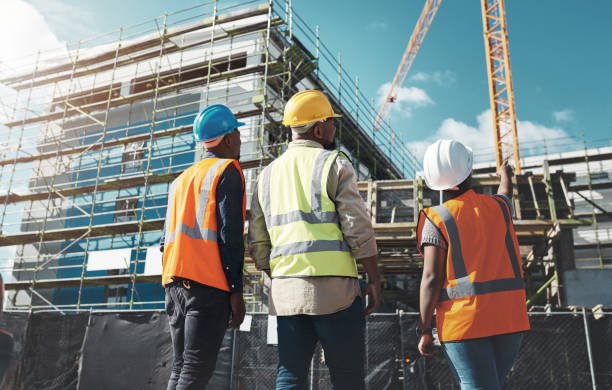
Every worker has to wear Personal Protective Equipment (PPE). This includes a hard hat to protect the head, steel-toed boots for the feet, high-visibility vests so crane operators can see them, and safety glasses. If you are working more than six feet off the ground, you must wear a harness tied to a secure anchor point. If you slip, the harness catches you.
There are strict rules called OSHA regulations (in the US) that dictate everything. There are rules for how deep you can dig a trench without shoring up the walls so they don’t collapse. There are rules for how to lock out a machine so it doesn’t turn on while someone is fixing it. Every morning starts with a “Safety Talk” where the crew discusses the specific dangers of the day. “Today we are lifting steel beams, so nobody walk underneath the crane.” Accidents still happen, but the industry is working hard to reach “Zero Incidents.” A safe site is a productive site.
The Bottom Line Managing Budgets and Timelines Effectively
Commercial and industrial projects are expensive. We are talking about millions, sometimes billions, of dollars. Managing this money is a full-time job. The project manager has to track every penny. They use complex software to estimate costs. They have to guess how much steel will cost next year, how many hours the electricians will take, and how much the permits will cost.
But things always go wrong. This is called “Cost Overrun.” Maybe it rains for two weeks and nobody can work. Maybe the price of copper wire doubles. Maybe they dig a hole and find an old buried oil tank that has to be cleaned up. To handle this, every budget has a “Contingency Fund”—usually 10% extra money set aside for emergencies.
Timelines are just as important. In commercial construction, time is money. If a hotel isn’t finished by summer, they miss the tourist season and lose millions. Contracts often have “Liquidated Damages” clauses. This means if the builder is late, they have to pay the owner a fine for every day they are late. This creates huge pressure to stay on schedule. Managers use Gantt charts—visual timelines—to track progress. If the drywall crew is late, the painters can’t start, and the carpet layers can’t start. It is a domino effect. Keeping the dominoes falling in the right order is the art of project management.
Building the Future of Our Economy
Commercial and industrial construction is the invisible engine of our economy. When you see a crane in the sky, it means jobs are being created. It means a company is growing. It means the city is alive.
These buildings are more than just steel and concrete. They are the places where we invent the future. A new research lab might discover a cure for a disease. A new factory might build the electric cars that save the planet. A new school might teach the next generation of leaders.
The process of building them is a triumph of human cooperation. It takes architects dreaming up shapes, engineers doing the math, and skilled tradespeople working with their hands to make it real. It is loud, dirty, and difficult work, but it is also incredibly rewarding. When a construction worker drives past a skyscraper ten years later, they can point up and say, “I built that.” That sense of pride is what drives the industry forward. As we move into the future, these buildings will become greener, smarter, and more efficient, but the core challenge remains the same: bringing a vision to life, one beam at a time.