The Ultimate Guide to Production and Process Management: Mastering the Art of Making Things
Have you ever walked into a busy coffee shop and marveled at how fast they work? One person takes your order, another steams the milk, a third pulls the espresso shot, and somehow, within two minutes, a perfect hot latte is in your hand. It feels like magic, but it is not. It is the result of careful planning, training, and a system designed to work perfectly. This is the world of Production and Process Management. It is the engine that drives every business that makes something, whether it is a cup of coffee, a car, or a smartphone apps.
For many people, these terms sound boring and corporate. They imagine dusty factories and men in suits looking at clipboards. But the reality is that production and process management are about creativity and problem-solving. It is about taking a pile of raw materials—like wood, metal, or data—and turning them into something valuable that people want to buy. It is about figuring out the best, fastest, and cheapest way to do it without sacrificing quality. In 2026, this skill is more important than ever. Companies that master their processes win the market. Companies that ignore them go bankrupt. This guide is going to walk you through the fascinating mechanics of how things get made. We will strip away the complex business jargon and use simple, plain English to explain how you can organize your work, reduce waste, and build a machine that runs smoothly and profitably.
What is Production Management and Why Does It Matter?
Let’s start with the basics. Production Management is the act of managing the creation of goods and services. It is the “What” and the “How Much.” If you run a bakery, production management is deciding how many loaves of bread to bake today, ensuring you have enough flour, and making sure the ovens are on. It involves planning, organizing, directing, and controlling the production activities.
Think of it as the conductor of an orchestra. The conductor doesn’t play the violin or the drums. Their job is to make sure everyone plays together. If the violins start too early or the drums are too loud, the music sounds terrible. In a factory, if the raw materials arrive late, the machines sit idle. If the machines work too fast, you run out of storage space. Production management ensures that the flow of materials, people, and money is balanced. It transforms inputs (resources) into outputs (finished products). Without this management, a business is just a chaotic mess of people running around without direction. It provides the structure that allows a company to deliver on its promises to customers.
Unlocking the Secrets of Process Management
If Production Management is the “What,” then Process Management is the “How.” It focuses on the specific steps taken to create the product. It is about analyzing the recipe. Let’s go back to our coffee shop example. Production management says, “We need to make 500 coffees today.” Process management asks, “Is the milk steamer too far away from the espresso machine? Are the baristas walking too many steps? Can we change the order of operations to save ten seconds per cup?”
Process management is the art of optimization. It looks at a workflow and tries to find the bottlenecks. A bottleneck is a point in the process where everything slows down. Imagine a four-lane highway that suddenly merges into one lane. Traffic stops. In a factory, if you have a super-fast robot that makes parts but a slow human who has to inspect them, the robot has to stop and wait. That human is the bottleneck. Process management identifies these choke points and fixes them. It might involve moving equipment, changing the layout of the room, or rewriting the instructions. The goal is a smooth, continuous river of work where nothing stops and nothing is wasted.
The Critical Difference Between Production and Process
It is easy to confuse these two concepts because they work so closely together, but understanding the difference is key to success. Production is focused on the output. It cares about volume, deadlines, and quotas. It asks, “Did we ship 1,000 units today?” It is often short-term focused. It deals with the immediate challenges of getting the job done right now.
Process is focused on the method. It cares about efficiency, consistency, and stability. It asks, “Did we make those 1,000 units in the best possible way?” It is often long-term focused. A bad process can still hit a production target, but it might require everyone to work overtime and waste a lot of material. A good process hits the target easily at a lower cost. You can have high production with bad processes (which is expensive), or low production with good processes (which is a waste of potential). The magic happens when you have high production flowing through excellent processes. That is when a company becomes a market leader.
Eliminating Waste: The Core of Efficiency
In the world of manufacturing, there is one true enemy: Waste. We aren’t just talking about trash in the garbage bin. In business terms, waste is anything that does not add value to the customer. If a customer is paying for a chair, they are paying for the wood, the paint, and the assembly. They are not paying for the time the carpenter spent walking across the shop to find a hammer. That walking time is waste.
There are many types of waste. “Waiting” is a big one—employees standing around because a machine is broken. “Overproduction” is another—making too much stuff that just sits in a warehouse gathering dust. “Defects” are the worst type of waste—making something broken that has to be thrown away. Process management is a war against these wastes. We use a philosophy called “Lean Manufacturing.” The idea is to strip away everything that isn’t essential. By organizing the workspace so tools are within reach, by maintaining machines so they don’t break, and by only making what is ordered, we reduce waste. This saves massive amounts of money and increases profit without having to raise prices.
The Art of Planning and Scheduling
You cannot run a production line on hope. You need a plan. Production planning is the roadmap. It looks at the future and says, “We expect to sell 5,000 widgets next month. To do that, we need to buy 5,000 pounds of steel today.” It works backward from the deadline.
Scheduling is the detailed timetable. It assigns specific tasks to specific people and machines at specific times. Ideally, a schedule ensures that a machine never sits empty. It aligns the arrival of materials with the availability of workers. We use tools like Gantt charts—visual timelines that show how long each step takes. If Step A takes 3 days and Step B takes 2 days, we know the whole job takes 5 days.
However, a good schedule must be flexible. Machines break. Workers get sick. Suppliers are late. If your schedule is too rigid, one small problem can destroy the whole month. Good managers build “buffers” into their schedule. They leave a little extra time for the unexpected. They prioritize the most important jobs so that if something has to be dropped, it is the least valuable task. Planning is not about predicting the future perfectly; it is about being prepared for whatever the future throws at you.
Inventory Management: The Goldilocks Principle
Inventory is money sitting on a shelf. If you are a car manufacturer, every tire, steering wheel, and engine sitting in your warehouse is cash that you cannot use. You had to pay for it, but you haven’t sold it yet. This is why Inventory Management is a balancing act.
If you have too much inventory, you have “holding costs.” You have to pay for the warehouse space, the electricity to light it, and the security guards to watch it. Plus, the inventory might spoil (if it is food) or become obsolete (if it is technology). This is bad.
But if you have too little inventory, you have “stockouts.” If a customer wants to buy a car and you say, “Sorry, we are out of steering wheels,” they will go to your competitor. This is also bad. You need the “Goldilocks” amount: just right. We use a strategy called “Just-in-Time” (JIT). The goal is to have the materials arrive at the factory exactly when they are needed, not a day sooner. It requires great relationships with suppliers and precise scheduling, but when it works, it drastically lowers costs and frees up cash to grow the business.
Quality Control: Ensuring Excellence Every Time
Speed is important, but not if the product is garbage. If you make 1,000 phones an hour but half of them don’t work, you haven’t really made anything; you have just created a disaster. Quality Control (QC) is the policeman of the production line. It ensures that the final product meets the standards the customer expects.
Quality control shouldn’t just happen at the end. If you wait until the car is fully built to check if the engine starts, you have wasted a lot of time. QC needs to happen at every step. Check the raw metal when it arrives. Check the welding halfway through. Check the paint job before assembly. This way, you catch mistakes early when they are cheap to fix.
We also use “Statistical Process Control.” Instead of checking every single screw (which takes too long), we check a random sample—say, every 100th screw. If that screw is perfect, we assume the rest are too. If that screw is bad, we stop the line and investigate. Consistency is key. Customers trust brands that deliver the exact same experience every time. A Big Mac tastes the same in London as it does in Tokyo. That is the triumph of quality control processes.
Continuous Improvement: The Spirit of Kaizen
The job of a production manager is never finished. You can always be faster. You can always be cheaper. You can always be better. This mindset is called “Continuous Improvement.” In Japan, it is known as “Kaizen.” It is the philosophy that small, daily changes add up to massive results over time.
Kaizen is not about buying a million-dollar robot to fix everything. It is about asking the workers on the floor for ideas. The person running the machine knows it better than the manager in the office. They might say, “Hey, if we move this bin of screws two feet to the left, I can reach it faster.” That change costs nothing, but it might save two seconds per cycle. Over a year, those two seconds add up to thousands of dollars.
It creates a culture where everyone is responsible for success. Instead of hiding mistakes, workers are encouraged to highlight them so the process can be fixed. It treats problems as opportunities. If a machine breaks, we don’t just fix it; we ask “Why did it break?” and “How do we prevent it from breaking again?” This relentless pursuit of perfection is what separates good companies from great ones. It ensures that the business evolves and stays competitive in a changing world.
Technology and the Future of Production
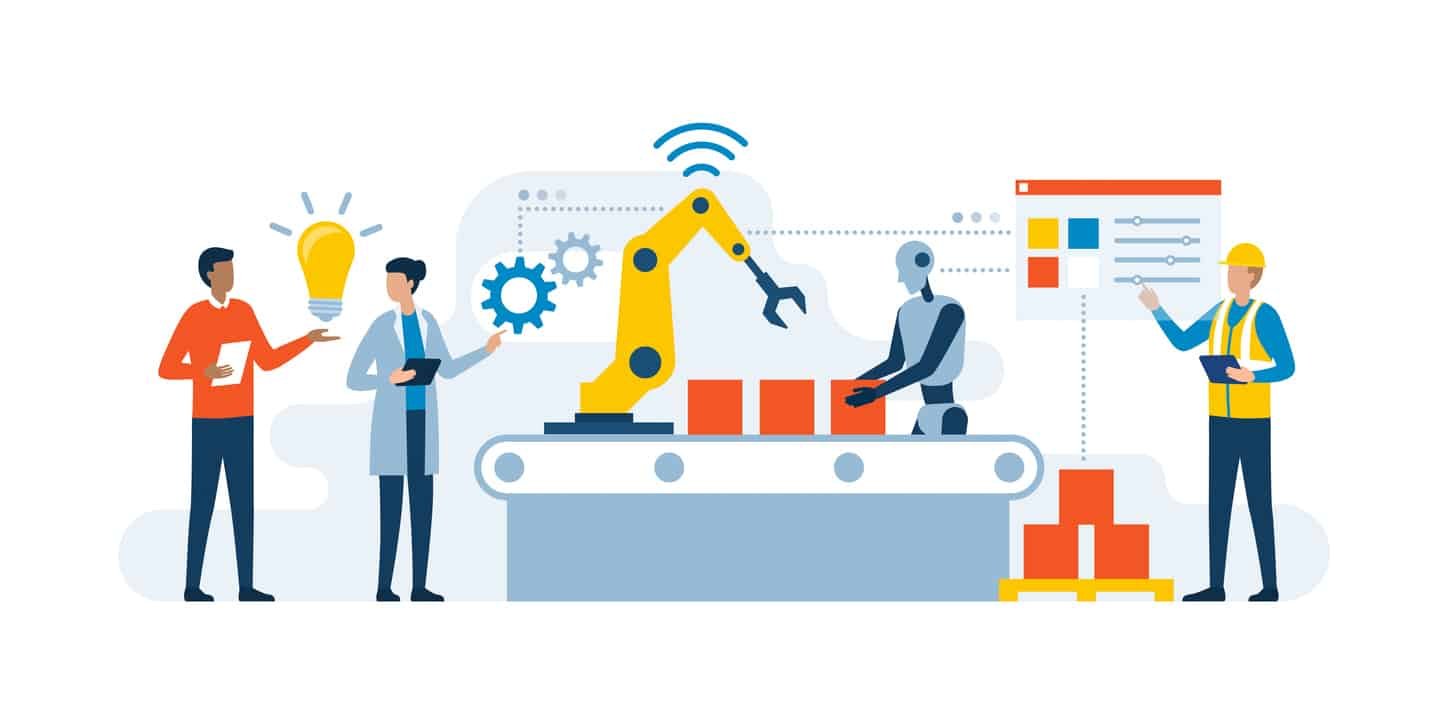
We are living in the Fourth Industrial Revolution, often called Industry 4.0. Technology is transforming production and process management faster than ever before. We are moving away from dirty, manual factories to “Smart Factories.”
Sensors are everywhere. A modern machine can “talk” to the computer system. It can say, “I am getting too hot, please slow down,” or “I am about to run out of oil.” This allows for predictive maintenance, fixing machines before they even break. We also have “Digital Twins”—virtual copies of the factory inside a computer. Managers can test a new process in the simulation to see if it works before trying it in the real world.
Automation and robotics are taking over the dangerous and boring jobs. Robots don’t get tired, they don’t get hurt, and they are incredibly precise. This doesn’t mean humans are obsolete; it means humans are moving to higher-level jobs. Instead of lifting heavy boxes, the human is now programming the robot that lifts the boxes. Software systems like ERP (Enterprise Resource Planning) connect the whole company, so when a salesperson sells a product, the factory instantly knows to make it. This connectivity makes the entire process faster, more transparent, and incredibly efficient.
Conclusion: The Human Element Behind the Machine
At the end of the day, production and process management is not just about machines and math. It is about people. It is about organizing human effort to create something meaningful. It is the backbone of our economy. Every object you touch—your clothes, your furniture, your food—went through a production process managed by someone.
By mastering these skills, you gain control over chaos. You learn to see the world as a series of interconnected steps. You learn to spot waste and value efficiency. Whether you are running a giant factory or just trying to organize your own small business, the principles are the same. Plan carefully. Measure everything. Fix problems early. And never stop improving.
When you get it right, it is a beautiful thing to watch. Raw materials flow in one door, and finished products flow out the other, like a well-oiled machine. Customers are happy because they get what they want on time. Employees are happy because their work is organized and safe. And the business is happy because it is profitable. That is the power of production and process management. It is the invisible force that builds the world around us. So, take a look at your own processes today. Where is the waste? Where is the bottleneck? There is always a better way to do it, and finding that way is the adventure of management.